
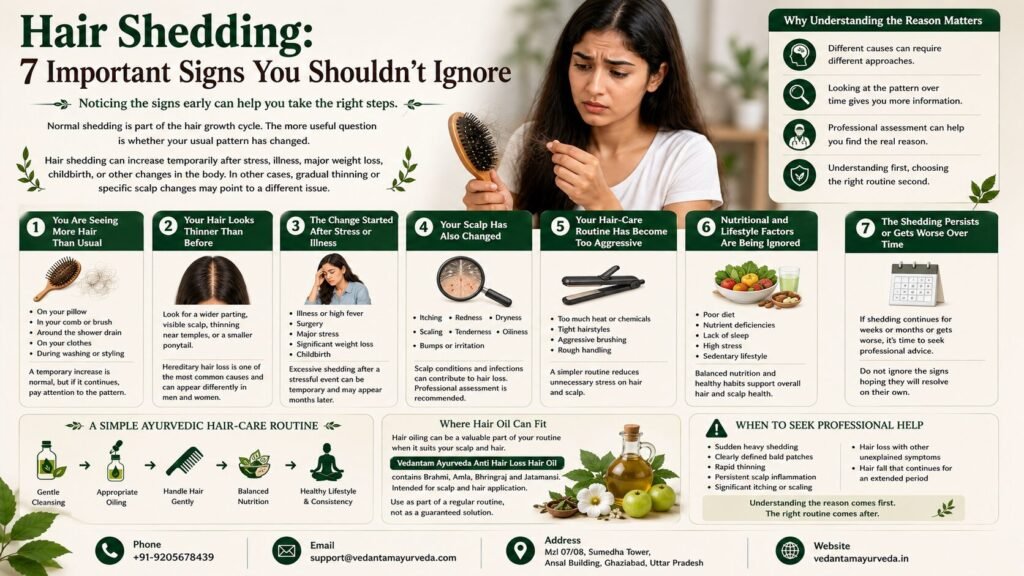
Seeing more hair than usual on your pillow, comb, or shower floor can be unsettling. But not every loose strand means you are developing permanent hair loss.
Normal shedding is part of the hair growth cycle. The more useful question is whether your usual pattern has changed.
Hair shedding can increase temporarily after stress, illness, major weight loss, childbirth, or other changes in the body. In other cases, gradual thinning or specific scalp changes may point to a different issue. The American Academy of Dermatology notes that understanding the reason behind increased shedding or hair loss is important because different causes can require different approaches.
So instead of immediately changing your shampoo or buying another hair product, start by paying attention to what has actually changed.
1. You Are Seeing More Hair Than Usual
Everyone loses some hair every day.
The American Academy of Dermatology says that shedding around 50 to 100 hairs a day can be normal. The exact amount is not as important as noticing a clear change from your normal pattern.
You may notice more strands:
- On your pillow after sleeping
- In your comb or brush
- Around the shower drain
- On your clothes
- During washing or styling
A temporary increase does not automatically mean permanent hair loss. However, if the change continues, it is worth paying attention to the pattern rather than ignoring it.
2. Your Hair Looks Thinner Than Before
Sometimes the first sign is not the amount of hair in your brush.
You may notice that your parting looks wider, your scalp is easier to see, or your ponytail feels smaller than it used to.
Gradual thinning can have several causes, including hereditary hair loss. The American Academy of Dermatology explains that hereditary hair loss is one of the most common causes of hair loss and can appear differently in men and women.
This is why comparing your hair only from one day to another can be misleading. Looking at photographs taken several weeks or months apart can give you a better idea of whether there has been a real change.
3. The Change Started After Stress or Illness
One reason hair shedding can suddenly become noticeable is a major physical or emotional stressor.
Increased shedding can occur after:
- A significant illness
- High fever
- Surgery
- Major stress
- Significant weight loss
- Childbirth
The American Academy of Dermatology explains that excessive shedding after a stressful event can sometimes be temporary and may become noticeable months after the event itself.
That delay can make the connection difficult to recognise.
You may think your shampoo caused the problem because the shedding started recently, while the actual trigger happened several weeks or months earlier.
4. Your Scalp Has Also Changed
Hair and scalp should not always be considered separately.
Pay attention if increased hair shedding appears together with:
- Persistent itching
- Redness
- Scaling
- Tenderness
- Unusual dryness
- Excessive oiliness
- New bumps or irritated areas
Scalp conditions and infections can sometimes contribute to hair loss. The American Academy of Dermatology lists scalp infections among the possible causes of hair loss.
If these symptoms continue, repeatedly changing cosmetic products is not the best way to find the cause. Professional assessment may be more appropriate.
5. Your Hair-Care Routine Has Become Too Aggressive
The way you treat your hair can affect its condition.
Frequent chemical treatments, excessive heat, tight hairstyles, aggressive brushing, or rough handling can contribute to hair damage and, in some situations, hair loss.
A simpler routine can help reduce unnecessary stress on the hair.
Try to:
- Handle wet hair gently.
- Avoid pulling or tugging while brushing.
- Reduce unnecessary heat styling.
- Avoid hairstyles that continuously pull on the scalp.
- Choose cleansing products according to your scalp needs.
The goal is not to stop using every hair product. It is to stop treating your hair more aggressively than necessary.
A Simple Ayurvedic Hair-Care Routine
Ayurveda traditionally takes a broader view of personal care, considering factors such as lifestyle, nourishment and individual constitution rather than treating every person with exactly the same routine.
For everyday hair care, simplicity can still be useful.
A basic routine may include gentle cleansing, appropriate oiling, careful handling of the hair, balanced nutrition and consistent lifestyle habits.
Where Hair Oil Can Fit
Hair oiling is a familiar part of traditional Ayurvedic hair care.
If oiling suits your scalp and hair, it can be included as one part of your routine rather than treated as a guaranteed solution for every type of hair concern.
Vedantam Ayurveda Anti Hair Loss Hair Oil is an available hair-care option on the Vedantam Ayurveda website and contains ingredients such as Brahmi, Amla, Bhringraj and Jatamansi. The product is intended for external use.
Use it as part of a consistent routine and follow the product’s usage instructions. Persistent or unusual shedding should still be evaluated separately.
Choosing a Shampoo for Regular Cleansing
A clean scalp is an important part of basic hair care, but more washing is not automatically better.
Vedantam Ayurveda Hair Fall Control Natural Shampoo contains ingredients including Amla, Bhringraj, Neem and Shikakai and is positioned by the brand for hair and scalp care.
Choose a shampoo based on your scalp and hair needs rather than changing products every few days.
6. Your Diet and Lifestyle Have Changed
Hair care does not begin and end with shampoo and oil.
Overall nutrition can matter when someone experiences excessive shedding. The American Academy of Dermatology notes that inadequate intake of nutrients such as iron, protein or zinc can be associated with noticeable hair loss.
Instead of immediately buying a hair supplement, look at your overall diet first.
Include a variety of:
- Protein-rich foods
- Lentils and legumes
- Nuts and seeds
- Vegetables
- Fruits
- Whole grains
- Other nutrient-rich foods appropriate for your diet
Sleep and stress management also deserve attention. A good routine cannot guarantee that shedding will stop, but ignoring basic health habits while constantly changing hair products is unlikely to be a sensible strategy.
7. The Shedding Is Persistent or Becoming More Noticeable
This is the point where guessing becomes less useful.
If hair shedding continues, becomes heavier, or appears together with visible thinning or bald patches, finding the underlying cause matters.
Hair loss can have many causes, including hereditary factors, autoimmune conditions, hormonal changes, nutritional deficiencies, certain medications, scalp conditions and physical or emotional stressors.
There is no single hair-care product that can address every one of these causes.
If you are concerned, a dermatologist or appropriate healthcare professional can help determine whether you are experiencing increased shedding, hair loss, breakage, or another scalp problem.
What You Should Not Do
When people become worried about hair shedding, they often make the routine more complicated.
They may:
- Change shampoo every week
- Apply several oils together
- Start multiple supplements at once
- Use excessive heat
- Follow unverified internet remedies
- Stop prescribed medication without medical advice
That approach makes it difficult to understand what is actually happening.
The better approach is to simplify first, observe the pattern, and investigate persistent changes instead of trying everything at once.
When Should You Get Professional Advice?
Consider getting your hair and scalp evaluated if you notice:
- Sudden or severe shedding
- Clearly defined bald patches
- Rapid thinning
- Persistent scalp inflammation
- Significant itching or scaling
- Hair loss with other unexplained symptoms
- Continued shedding that concerns you
The NHS also advises seeking medical advice if you are worried about hair loss, particularly because some causes are temporary while others may require treatment.
The Better Question to Ask
Instead of asking:
“Which product will stop my hair fall?”
try asking:
“What changed before my hair started behaving differently?”
That question is more useful.
Think about your recent illness, stress levels, diet, weight changes, medications, hairstyle, scalp condition and hair-care routine.
Once you understand the pattern, it becomes easier to decide what needs attention.
Final Thoughts
Not every increase in hair shedding means permanent hair loss.
Sometimes the change is temporary. Sometimes it reflects a lifestyle or health event. In other cases, gradual thinning may need proper evaluation.
A sensible hair-care routine should therefore be simple: keep the scalp clean, handle the hair gently, use suitable products, maintain balanced nutrition and pay attention to changes over time.
Ayurvedic hair care can be part of that routine, but no oil or shampoo should be presented as a guaranteed answer to every type of hair loss.
The most useful first step is understanding what has changed.
Once the cause is clearer, the right approach becomes much easier to choose.
Frequently Asked Questions
How much hair shedding is normal?
The American Academy of Dermatology notes that losing around 50 to 100 hairs per day can be normal. What matters more is whether your usual shedding pattern has noticeably changed.
Can stress increase hair shedding?
Yes. Significant physical or emotional stress can be associated with increased shedding, and the change may become noticeable some time after the stressful event.
Does oiling stop hair shedding?
Oiling can be part of a hair-care routine, but it should not be treated as a guaranteed solution for every cause of shedding or hair loss.
Should I change my shampoo if I notice more shedding?
Not automatically. First consider whether your scalp has changed and whether other factors such as stress, illness, nutrition or hair practices have changed.
When should I see a dermatologist?
If shedding is sudden, severe, persistent, patchy, or accompanied by scalp symptoms or visible thinning, professional evaluation can help identify the cause.