
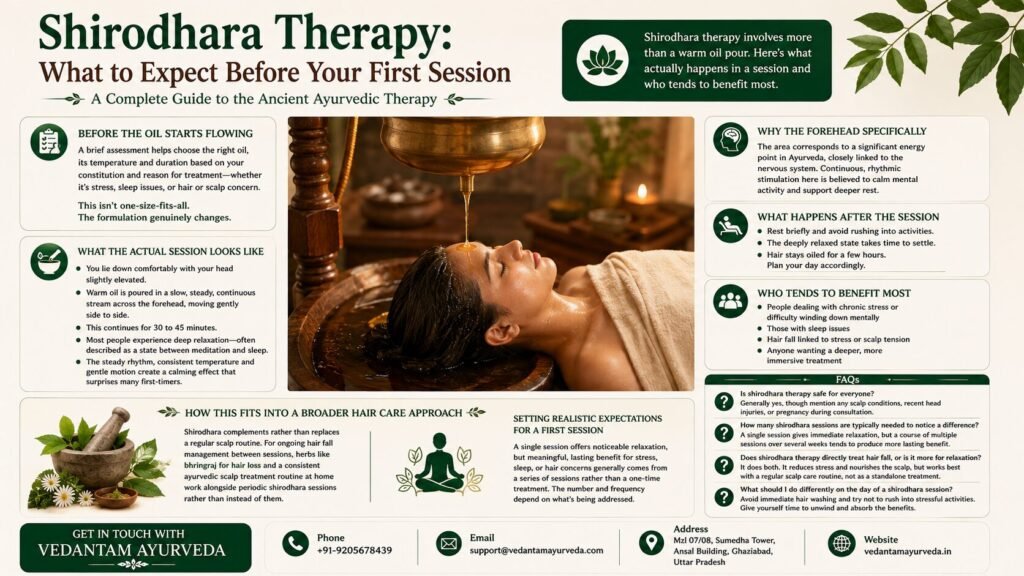
Shirodhara therapy is often described in a single sentence, warm oil poured continuously over the forehead, which technically captures the mechanics but misses most of what actually happens during a session. A proper session begins with a brief assessment, since the specific oil used and its temperature are chosen based on individual constitution and the reason for treatment, whether that’s stress, sleep issues, or a hair or scalp concern. This isn’t a one-size-fits-all pour, the formulation genuinely changes depending on what the therapy is meant to address.
What the Actual Session Looks Like
Once positioned comfortably, usually lying down with the head slightly elevated, warm oil is poured in a slow, steady, continuous stream across the forehead, moving gently side to side rather than staying fixed in one spot. This continues for a set period, typically 30 to 45 minutes, during which most patients settle into a notably deep state of relaxation, often described as somewhere between meditation and sleep.
The sensation itself surprises a lot of first-timers. The steady rhythm of the oil, combined with the consistent temperature and the gentle repetitive motion, tends to have a calming effect that’s difficult to fully anticipate before experiencing it directly.
Why the Forehead Specifically
The area targeted corresponds to what Ayurveda considers a particularly significant energy point, closely linked to the nervous system. The continuous, rhythmic stimulation here is believed to calm mental activity and support deeper rest, which is part of why shirodhara is used as much for stress and sleep concerns as for hair or scalp issues specifically.
What Happens After the Session
Most patients are advised to rest briefly rather than rushing straight back into activity, since the deeply relaxed state achieved during the session can take a little time to fully settle. Hair typically stays oiled for a few hours afterward, so planning the session on a day without immediate plans to wash it out tends to work better.
Who Tends to Benefit Most
- People dealing with chronic stress or difficulty winding down mentally
- Those with sleep issues that haven’t responded well to other approaches
- Hair fall linked to stress or scalp tension specifically, rather than purely nutritional causes
- Anyone wanting a deeper, more immersive treatment than a standard oil massage provides
How This Fits Into a Broader Hair Care Approach
Shirodhara complements rather than replaces a regular scalp routine. For ongoing hair fall management between sessions, herbs like bhringraj for hair loss and a consistent ayurvedic scalp treatment routine at home work alongside periodic shirodhara sessions rather than instead of them.
Setting Realistic Expectations for a First Session
A single session offers noticeable relaxation, but meaningful, lasting benefit for stress, sleep, or hair concerns generally comes from a series of sessions rather than a one-time treatment. How many sessions and how frequently depends on what’s being addressed and is best determined during an initial consultation rather than assumed beforehand.
The Research Behind Oil Therapy and Stress Relief
Research on massage therapy and cortisol reduction has found that consistent, rhythmic touch therapies measurably lower stress hormone levels, which lines up with the calming effect shirodhara therapy is traditionally known for, even though the specific mechanism described in Ayurveda predates this kind of modern research by centuries.
FAQs
Is shirodhara therapy safe for everyone?
Generally yes, though it’s worth mentioning any scalp conditions, recent head injuries, or pregnancy during consultation, since these can affect whether and how the treatment is adapted.
How many shirodhara sessions are typically needed to notice a difference?
A single session provides immediate relaxation, but a course of multiple sessions, often recommended over several weeks, tends to produce more lasting benefit for stress, sleep, or hair-related concerns.
Does shirodhara therapy directly treat hair fall, or is it more for relaxation?
It does both to some degree, the stress-reducing effect can indirectly support hair fall linked to tension, while the oil itself also nourishes the scalp, though it works best combined with a regular scalp care routine rather than as a standalone hair fall treatment.
What should I do differently on the day of a shirodhara session?
Avoid scheduling anything requiring immediate hair washing afterward, since oil typically stays in for a few hours, and try not to rush straight from the session into a stressful activity, since the relaxed state benefits from a bit of unwinding time.
Get in Touch with Vedantam Ayurveda
If you would like personalised guidance from our Ayurvedic experts, or want to explore our range of authentic Ayurvedic products, we would love to hear from you.
- Phone: +91-9205678439
- Email: support@vedantamayurveda.com
- Address: Mzl 07/08, Sumedha Tower, Ansal Building, Ghaziabad, Uttar Pradesh
- Website: vedantamayurveda.in