
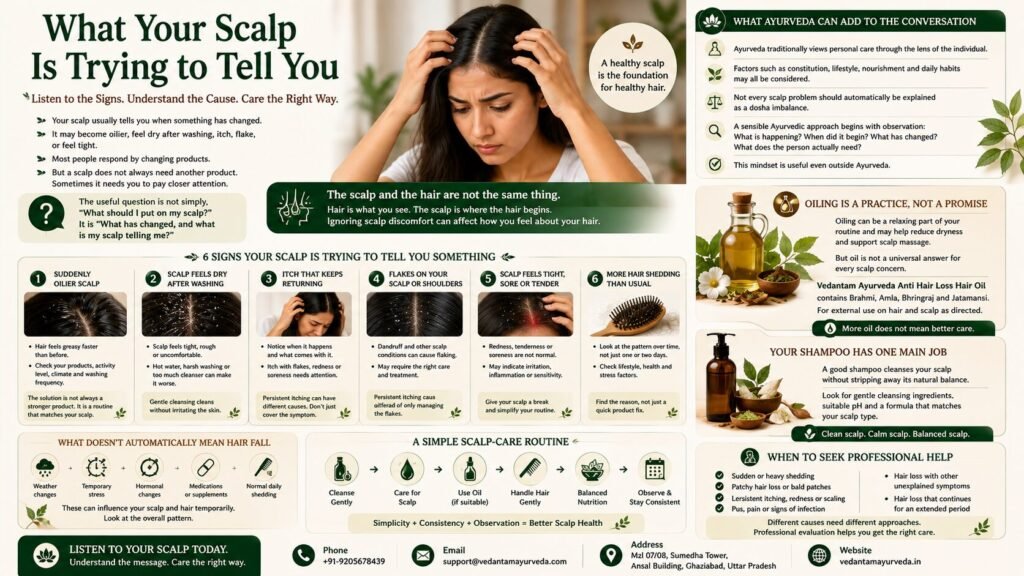
Your scalp usually tells you when something has changed.
It may become oilier than usual. It may feel dry after washing. You may notice flakes on your shoulders, an itch that keeps returning, or a strange tightness that was not there before.
Most people respond by changing products.
New shampoo. New oil. New serum. Sometimes all three.
But a scalp does not always need another product. Sometimes it needs you to pay closer attention.
The useful question is not simply, “What should I put on my scalp?”
It is “What has changed, and what is my scalp telling me?”
The Scalp and the Hair Are Not the Same Thing
Hair is what you see.
The scalp is where the hair begins.
That distinction sounds obvious, but it is easy to forget. We often judge our hair by how shiny, thick or smooth it looks while overlooking the skin underneath.
An uncomfortable scalp can affect how you feel about your hair, but the reason behind that discomfort can vary.
Excess oil, dryness, product buildup, irritation, dandruff and other scalp conditions do not all require the same approach.
That is why copying someone else’s hair routine rarely works perfectly.
When Your Scalp Suddenly Becomes Oily
An oily scalp is not automatically an unhealthy scalp.
Your skin naturally produces sebum, and some people simply produce more than others.
The more useful question is whether the amount has changed.
Maybe your hair used to look fresh for two days and now feels greasy by the end of the day. Maybe you have started using heavier styling products. Perhaps you are sweating more because of the weather or exercise.
Before blaming your shampoo, look at the entire routine.
Ask yourself:
- Did I change any products recently?
- Am I using more styling products?
- Has my activity level changed?
- Am I washing too infrequently for my scalp?
- Has the weather become hotter or more humid?
Sometimes the solution is not a stronger product. It is simply a routine that better matches your scalp.
When Your Scalp Feels Dry After Washing
Dryness can be confusing because many people immediately reach for more oil.
But more oil is not always the answer.
A scalp can feel dry or uncomfortable for several reasons, including environmental conditions, product irritation or an overly aggressive cleansing routine.
If your scalp feels tight immediately after washing, consider how you are washing it.
Very hot water, excessive scrubbing and using more cleanser than necessary can make a routine feel harsher than it needs to be.
Gentle does not mean ineffective.
It means cleaning without unnecessarily irritating the skin.
And Then There Is the Itch
An occasional itch is not unusual.
An itch that keeps returning deserves more attention.
Think about when it happens.
Is it immediately after using a particular product? Does it appear alongside flakes? Is the scalp red or sore? Does scratching provide only temporary relief?
Those details are more useful than simply deciding that your scalp is “dry.”
Persistent itching can have different causes. The American Academy of Dermatology notes that dandruff and other scalp conditions can produce itching and flaking and may require appropriate treatment. American Academy of Dermatology — Dandruff
So if your scalp keeps asking for attention, do not keep covering the symptom with another product.
What Ayurveda Can Add to the Conversation
Ayurveda has traditionally viewed personal care through the lens of the individual.
That means the same routine is not necessarily appropriate for everyone.
In Ayurvedic thinking, factors such as constitution, lifestyle, nourishment and daily habits may all be considered when developing a care routine.
But there is an important distinction here.
Not every scalp problem should automatically be explained as a dosha imbalance.
That would make the idea of individualized care meaningless.
A sensible Ayurvedic approach should begin with observation: What is happening? When did it begin? What has changed? What does the person actually need?
That mindset is useful even outside Ayurveda.
Oiling Is a Practice, Not a Promise
Hair oiling has a long place in traditional Indian and Ayurvedic hair care.
For some people, it can be an enjoyable part of their routine. It can help reduce the feeling of dryness in the hair and make scalp massage part of a relaxing self-care practice.
But oil should not be marketed as a universal answer to every hair or scalp concern.
Vedantam Ayurveda’s Anti Hair Loss Hair Oil contains ingredients including Brahmi, Amla, Bhringraj and Jatamansi and is designed for external hair and scalp application.
If you choose to include an oil in your routine, use it according to the product’s directions and pay attention to how your scalp responds.
More oil does not mean better care.
Your Shampoo Has One Main Job
There is a lot of marketing around shampoos.
“Strengthening.”
“Repairing.”
“Growth.”
“Anti-hair fall.”
But at the most basic level, shampoo is a cleansing product.
It helps remove sweat, excess oil, dirt and product buildup from the scalp and hair.
That basic job matters.
Vedantam Ayurveda’s Hair Fall Control Natural Shampoo contains ingredients including Amla, Bhringraj, Neem and Shikakai and is positioned by the brand for hair and scalp care.
The important thing is not to keep changing shampoos every few days.
Choose a product that suits your scalp, use it consistently, and observe how your scalp responds.
The Mistake of Doing Too Much
This is probably one of the most common problems in modern hair care.
A person notices flakes.
They buy an anti-dandruff shampoo.
Then an oil.
Then a serum.
Then a scalp mask.
Then a supplement.
Within a month, they are using five different things and still do not know what caused the original problem.
More products create more variables.
A simpler routine is easier to understand.
Cleanse appropriately. Use products that suit your scalp. Avoid unnecessary irritation. Give your routine time to show you how your scalp responds.
That is not exciting advice.
It is practical advice.
Your Lifestyle Can Show Up on Your Scalp Too
The scalp does not exist separately from the rest of you.
Your overall diet, sleep, stress, illness, medications and daily routine can all be relevant when you notice changes in your hair or scalp.
That does not mean every scalp issue is caused by stress or poor nutrition.
It means the bigger picture deserves attention.
If your hair or scalp changes at the same time as a major change in your health or lifestyle, make a note of it.
Patterns are often more useful than assumptions.
When You Should Stop Experimenting
There is a point where trying another product stops being useful.
If you have persistent:
- Itching
- Redness
- Pain
- Significant scaling
- Sores
- Sudden patchy hair loss
- Rapid thinning
- Unusual scalp changes
it is better to get the problem properly assessed.
The NHS advises seeking medical advice when you are concerned about hair loss because the underlying causes can vary. NHS — Hair Loss
A cosmetic product cannot diagnose a medical condition.
And an Ayurvedic product should not be presented as a guaranteed treatment for every scalp problem.
A Better Way to Build Your Routine
Instead of building your routine around products, build it around observations.
First, notice.
Is your scalp oily, dry, itchy, flaky or comfortable?
Then simplify.
Remove unnecessary products and avoid constantly changing your routine.
Then choose.
Select cleansing and hair-care products according to what your scalp actually needs.
Finally, reassess.
If something continues or becomes worse, do not keep experimenting indefinitely.
That approach is slower than buying the latest product.
It is also much more sensible.
The Scalp Comes First
Healthy-looking hair is not created only by what you apply to the strands.
The scalp deserves attention because it is part of the environment in which your hair grows.
That does not mean you need an elaborate routine.
It means noticing changes, avoiding unnecessary irritation and choosing products with a reason rather than following every new trend.
Ayurvedic hair care can fit naturally into this approach when it is personalized and used realistically.
The goal is not to find one magical product.
The goal is to understand your scalp well enough to know when it needs less, when it needs a different routine, and when it needs professional attention.
Frequently Asked Questions
How do I know if my scalp is healthy?
A comfortable scalp without persistent itching, significant flaking, redness, pain or unusual irritation is generally a good sign. Sudden changes deserve attention.
Is an oily scalp a bad thing?
Not necessarily. Sebum is a normal part of scalp function. The important factor is whether excessive oiliness is accompanied by discomfort, buildup or other changes.
Should I oil my scalp every day?
Not necessarily. The ideal frequency depends on your scalp, hair type and the product being used. More frequent oiling is not automatically better.
Can oiling help a dry scalp?
Oil may help some people with the feeling of dryness, but persistent flaking or itching should not automatically be assumed to be simple dryness.
Should I change my shampoo if my scalp is itchy?
Not immediately. Consider whether the symptoms started after a new product, whether there is flaking or redness, and whether the problem continues. Persistent symptoms may require professional evaluation.
Can Ayurveda be part of a scalp-care routine?
Yes. Ayurvedic practices can be incorporated into an individualized hair and scalp routine. They should not, however, replace appropriate medical evaluation for persistent or unusual scalp problems.
Our Contact
+91-9205678439
support@vedantamayurveda.com
Mzl 07/08 Sumedha Tower, Ansal Building.