
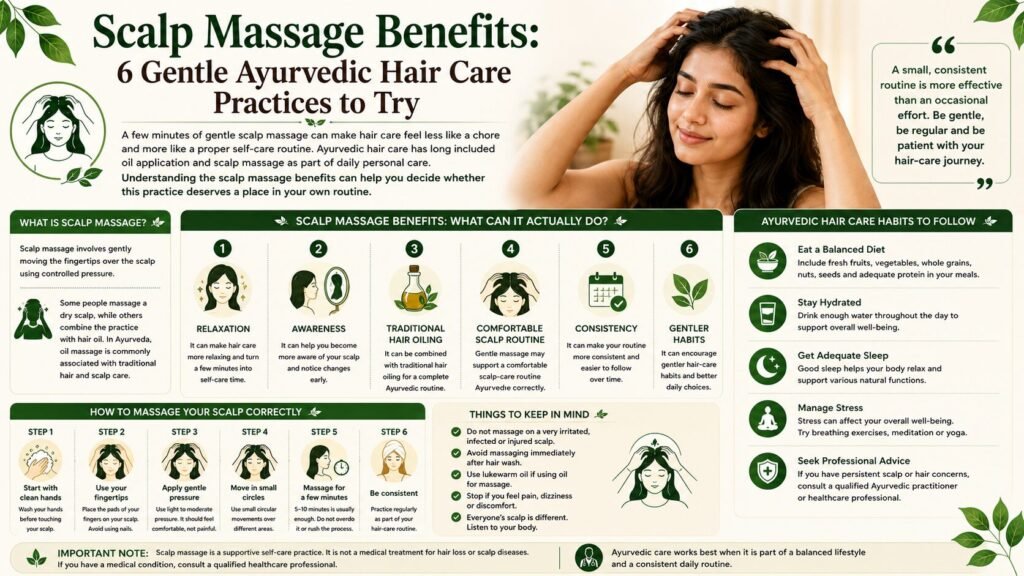
A few minutes of gentle scalp massage can make hair care feel less like a chore and more like a proper self-care routine.
The technique matters, though. Pressing too hard, scratching with the nails or repeatedly massaging an irritated scalp can do more harm than good.
Traditional Ayurvedic hair care has long included oil application and scalp massage as part of personal care. Today, these practices can be approached in a simple way without turning them into a complicated routine.
Understanding the scalp massage benefits can help you decide whether this practice deserves a place in your own hair-care routine.
What Is Scalp Massage?
Scalp massage involves gently moving the fingertips over the scalp using controlled pressure.
Unlike scratching, the aim is not to scrape the scalp. The fingertips should move comfortably across the skin without causing pain or irritation.
Some people massage a dry scalp, while others combine the practice with hair oil.
In Ayurvedic routines, oil massage is commonly associated with traditional hair and scalp care.
Scalp Massage Benefits: What Can It Actually Do?
Scalp massage is best viewed as a personal-care practice rather than a guaranteed treatment for hair problems.
1. It Can Make Hair Care More Relaxing
One of the simplest reasons people enjoy scalp massage is the experience itself.
Slow, gentle movements can become a relaxing part of an evening routine. Taking a few minutes away from screens and daily tasks may make the practice feel more like self-care.
However, relaxation should not be confused with a medical treatment.
2. It Can Help You Become More Aware of Your Scalp
Regularly touching your scalp gently can make you more aware of changes.
You may notice dryness, unusual tenderness, irritation or areas that feel different from the rest of your scalp.
That awareness can be useful because it encourages you to pay attention rather than ignoring a persistent problem.
3. It Can Be Combined With Traditional Hair Oiling
Oil application is a familiar part of many Ayurvedic hair-care routines.
A small amount of suitable hair oil can be applied before a gentle massage. The important point is to avoid aggressive rubbing.
Vedantam Ayurveda describes Ayurvedic hair oils and hair-care practices among its services. Its approach includes traditional methods such as oiling and scalp-focused care.
4. Gentle Massage May Support a Comfortable Scalp Routine
A massage should feel comfortable rather than painful.
Use the pads of your fingers and move slowly across different areas of the scalp. Avoid using your fingernails.
If your scalp feels sore, inflamed or unusually sensitive, massage is not something to push through.
5. It Can Make Your Routine More Consistent
Hair care often works better as a routine than as an occasional experiment.
A short massage can be attached to another regular habit, such as your evening hair-care routine.
The goal is not to spend a long time massaging the scalp. A few comfortable minutes may be enough for the personal-care aspect of the practice.
6. It Can Encourage Gentler Hair-Care Habits
Once you start paying attention to your scalp, you may also become more careful about other habits.
For example, you may reduce:
- Aggressive scratching
- Excessive heat
- Very hot water
- Rough towel drying
- Unnecessary product changes
- Tight hairstyles
These simple changes can make everyday hair care more comfortable.
How to Massage Your Scalp Correctly
Technique is more important than force.
Step 1: Start With Clean Hands
Wash your hands before touching your scalp.
This keeps unnecessary dirt and product residue away from the scalp.
Step 2: Use Your Fingertips
Place the pads of your fingers against the scalp.
Do not use your fingernails. Scratching can irritate the skin.
Step 3: Use Small Circular Movements
Move your fingertips in small, gentle circles.
Start near the front of the scalp and gradually work towards the sides and back.
Step 4: Keep the Pressure Comfortable
There is no benefit in pressing as hard as possible.
A massage should not cause pain, burning or significant redness.
Step 5: Stop if Your Scalp Becomes Irritated
If your scalp becomes uncomfortable, stop the massage.
Persistent itching, scaling, redness or pain should be assessed rather than repeatedly massaged.
Should You Use Hair Oil During a Scalp Massage?
You can combine oiling with scalp massage if the product is suitable for you.
However, more oil does not automatically mean better hair care.
Use the amount recommended for the particular product and avoid soaking the scalp unnecessarily.
Vedantam Ayurveda currently lists Folliserv Hair Oil on its website, containing ingredients such as hibiscus, amla, rosemary and Redensyl. The product page currently shows it as out of stock, so availability should be checked before considering it for purchase.
This is also a good reminder to check the current product page rather than relying on an older article or product listing.
Ayurvedic Hair Care Beyond Scalp Massage
Scalp massage is only one part of a broader hair-care routine.
Gentle Cleansing
Keep your washing routine appropriate for your scalp.
Avoid very hot water and aggressive scrubbing.
Careful Drying
Wet hair can be handled gently. Avoid vigorous towel rubbing.
Avoid Excessive Heat
Frequent high-heat styling can leave hair feeling dry and rough.
Pay Attention to Your Scalp
Do not ignore persistent itching, scaling, redness or tenderness.
Keep Your Routine Practical
A routine that takes a reasonable amount of time is easier to maintain than one involving numerous unnecessary steps.
Can Scalp Massage Stop Hair Loss?
This is where it is important to separate personal-care practices from medical claims.
Scalp massage should not be presented as a guaranteed way to stop hair loss or regrow hair.
Hair loss can have many different causes, and the appropriate approach depends on the underlying issue.
If you are experiencing sudden, significant or persistent hair loss, it is better to seek professional assessment rather than relying only on massage or oiling.
The American Academy of Dermatology provides information about different forms of hair loss and professional evaluation. American Academy of Dermatology — Hair Loss
When Should You Avoid Scalp Massage?
Gentle massage is not appropriate for every scalp situation.
Be cautious if you have:
- Open wounds
- Significant inflammation
- Painful scalp lesions
- Active infection
- Severe irritation
- Unexplained tenderness
- Recent scalp procedures
If you are unsure whether massage is appropriate, ask a qualified healthcare professional.
Why Choose Vedantam Ayurveda for Hair Care?
Vedantam Ayurveda presents traditional Ayurvedic approaches alongside its hair and skin-care services.
Its website describes hair-focused services and Ayurvedic approaches for different hair concerns.
The benefit of professional consultation is that you can discuss your particular concern instead of choosing a treatment simply because it is popular online.
You can review Vedantam Ayurveda’s available services or contact the centre to discuss your requirements. Contact Vedantam Ayurveda
A Simple Scalp Massage Routine
If your scalp is comfortable and there is no reason to avoid massage, keep the routine simple.
Before Massage
- Wash your hands.
- Decide whether you want to use an appropriate hair oil.
- Make sure your scalp is free from obvious irritation.
During Massage
- Use your fingertips.
- Move slowly.
- Use small circular movements.
- Keep pressure comfortable.
- Avoid scratching.
After Massage
- Leave the hair oil on only according to the product directions.
- Wash the scalp appropriately.
- Avoid aggressive towel drying.
- Pay attention to how your scalp feels afterwards.
The routine should leave you feeling comfortable, not sore.
Common Mistakes to Avoid
Using Fingernails
Fingernails can scratch the scalp.
Use fingertips instead.
Pressing Too Hard
A stronger massage is not automatically more effective.
Applying Too Much Oil
Excessive oil can make washing more difficult and may not suit every scalp.
Massaging an Irritated Scalp
If the scalp is already painful or inflamed, repeatedly rubbing it is not a sensible solution.
Expecting Instant Hair Growth
Hair growth and hair loss are complex issues. A massage should not be marketed as an instant solution.
Final Thoughts
The main scalp massage benefits are best understood as part of a broader personal-care routine rather than as a guaranteed treatment for hair problems.
Gentle fingertip movements, sensible oiling and attention to scalp comfort can make hair care more intentional.
At the same time, persistent itching, inflammation, scaling or sudden hair loss should not simply be covered up with oil or massage.
Keep the routine simple, use comfortable pressure and pay attention to what your scalp is telling you.
Frequently Asked Questions
What are the main scalp massage benefits?
Scalp massage can be a relaxing personal-care practice, encourage gentler scalp habits and work naturally alongside traditional hair-oiling routines.
How long should a scalp massage last?
There is no medically required duration for general personal care. Keep it comfortable and avoid prolonged or aggressive rubbing.
Should I use oil during a scalp massage?
Oil can be included if it is suitable for your scalp and the product directions support its use. It is not necessary for every massage.
Can scalp massage regrow hair?
Scalp massage should not be presented as a guaranteed hair-regrowth treatment. Persistent or significant hair loss should be professionally assessed.
Can I massage an itchy scalp?
It depends on the cause of the itching. Avoid aggressive massage, especially if the scalp is inflamed, painful or irritated.
Should I use my nails for scalp massage?
No. Use the pads of your fingertips and avoid scratching with your nails.
Is scalp massage part of Ayurvedic hair care?
Oil application and massage are traditional components of many Ayurvedic personal-care practices. Individual suitability can vary.
Our Contact
- +91-9205678439
- support@vedantamayurveda.com
- Mzl 07/08 Sumedha Tower, Ansal Building.