
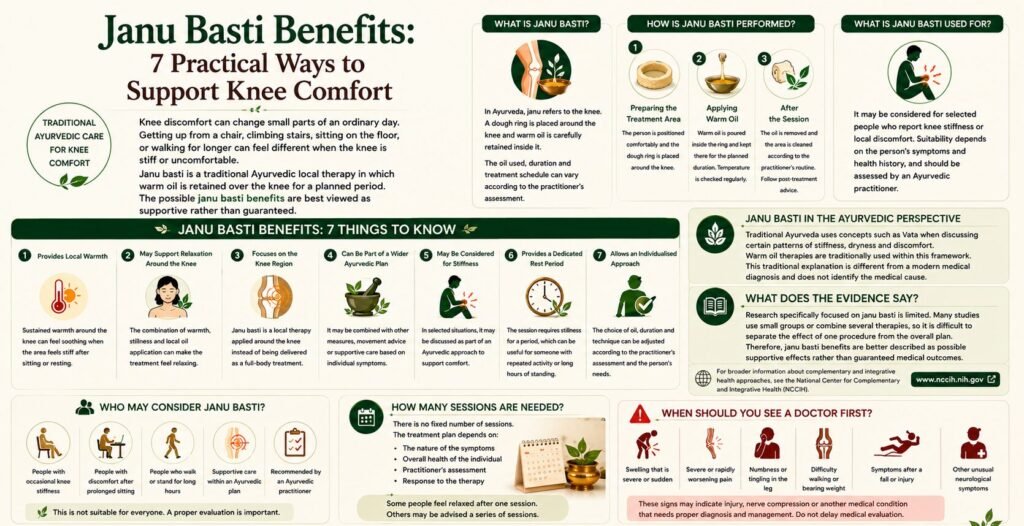
Knee discomfort can change small parts of an ordinary day. Getting up from a chair, climbing stairs, sitting on the floor, or walking for longer can feel different when the knee is stiff or uncomfortable.
Janu basti is a traditional Ayurvedic local therapy in which warm oil is retained over the knee for a planned period. The procedure is focused on the joint area rather than the whole body.
The possible janu basti benefits are best viewed as supportive rather than guaranteed. Warmth and local oil application may feel comfortable for some people, but the therapy should not be presented as a cure for every cause of knee pain.
What Is Janu Basti?
In Ayurveda, janu refers to the knee. During the procedure, a small dough ring is placed around the knee and warm oil is carefully retained inside it.
The practitioner maintains a comfortable temperature while the person remains in a relaxed position. The oil used, duration, and treatment schedule can vary according to the practitioner’s assessment.
How Is Janu Basti Performed?
Preparing the Treatment Area
The person is positioned comfortably and the knee is exposed without unnecessary strain. A dough ring is prepared and placed around the selected area.
Applying Warm Oil
Warm oil is poured inside the ring and kept there for the planned duration. The practitioner checks the temperature during the procedure so the treatment remains comfortable.
After the Session
The oil is removed and the area is cleaned according to the practitioner’s routine. Any post-treatment advice should be followed as provided.
Janu Basti Benefits: 7 Things to Know
1. Provides Local Warmth
One of the clearest janu basti benefits is the sustained warmth around the knee. A warm application can feel soothing when the area feels stiff after sitting or resting.
2. May Support Relaxation Around the Knee
The combination of warmth, stillness, and local oil application can make the treatment feel relaxing. This may be useful when the area feels tense or uncomfortable.
3. Focuses on the Knee Region
Janu basti is a local therapy. The procedure is applied around the knee instead of being delivered as a general full-body treatment.
4. Can Be Part of a Wider Ayurvedic Plan
An Ayurvedic practitioner may include the therapy with other appropriate measures, movement advice, or supportive care. The plan should be based on the individual’s symptoms rather than copied from another person’s routine.
5. May Be Considered for Stiffness
People sometimes seek local warmth when a knee feels stiff after inactivity. In selected situations, janu basti may be discussed as part of an Ayurvedic approach to comfort.
6. Provides a Dedicated Rest Period
A session requires the person to remain still for a period. That pause can be useful for someone whose normal routine involves repeated activity or prolonged standing.
7. Allows an Individualised Approach
The treatment can be adjusted according to the practitioner’s assessment, including the choice of oil and duration. This individual approach is more appropriate than using a fixed schedule for everyone.
Janu Basti in the Ayurvedic Perspective
Traditional Ayurveda uses concepts such as Vata when discussing certain patterns of stiffness, dryness, and discomfort. Warm oil therapies are traditionally used within this framework.
This traditional explanation is different from a modern medical diagnosis. A person should not assume that an Ayurvedic description identifies the medical cause of their knee symptoms.
What Does the Evidence Say About Janu Basti Benefits?
Research specifically focused on janu basti is limited. Some available Ayurvedic research uses small groups or combines several therapies, so it is difficult to separate the effect of one procedure from the overall treatment plan.
For that reason, janu basti benefits are better described as possible supportive effects rather than guaranteed medical outcomes.
For broader information about complementary and integrative health approaches, see the National Center for Complementary and Integrative Health.
NCCIH — complementary and integrative health
Who May Consider Janu Basti?
An Ayurvedic practitioner may consider local therapy for selected people who report knee stiffness or local discomfort. Suitability depends on the person’s symptoms and health history.
People with occasional knee stiffness
People who notice discomfort after prolonged sitting
People considering supportive Ayurvedic care for the knee
People who have been assessed and advised that local therapy is appropriate
When Should Knee Pain Be Assessed Medically?
Knee pain can have many causes. Injuries and conditions affecting the muscles, ligaments, cartilage, or joint may require assessment before any local therapy is considered.
Signs That Should Not Be Ignored
Severe or rapidly worsening pain
A significant injury or fall involving the knee
Marked swelling or redness
Inability to put weight on the leg
A knee that appears deformed or unstable
Fever or feeling significantly unwell together with knee symptoms
For general information about knee pain and when to seek medical help, see the NHS guidance on knee pain.
Daily Habits That Can Support Knee Comfort
Keep Movement Practical
Appropriate movement can be easier to maintain than long periods of complete inactivity. The right level of activity depends on the person’s condition.
Pay Attention to Repeated Strain
If a particular movement repeatedly increases discomfort, notice the pattern and discuss it with an appropriate professional rather than repeatedly pushing through the pain.
Look at the Whole Routine
Sleep, activity, footwear, work habits, and body weight can all influence how the knees feel. Local therapy makes more sense when it is considered alongside sensible daily habits.
Why Choose Vedantam Ayurveda?
Choosing an Ayurvedic clinic for a therapy such as janu basti is not only about the procedure itself. How the treatment is assessed and included in a wider care plan also matters.
Vedantam Ayurveda presents its approach around personalised Ayurvedic care. For a therapy such as janu basti, that means discussing the person’s symptoms and considering whether the treatment is appropriate for the individual.
The clinic also provides Ayurvedic therapies and products. If you are considering janu basti for ongoing knee discomfort, you can review the clinic’s services and contact information before deciding on a consultation.
Final Thoughts
Janu basti is a traditional Ayurvedic local therapy that uses warm oil around the knee. The warmth and quiet treatment setting may support comfort for some people, particularly when stiffness is part of the complaint.
The possible janu basti benefits should still be viewed realistically. The therapy is not a guaranteed cure and should not delay assessment when symptoms are severe, persistent, or linked to an injury.
A sensible approach is to understand the symptoms, seek appropriate professional guidance, and consider Ayurvedic care as part of a wider plan when it is suitable.
Frequently Asked Questions
What are the main janu basti benefits?
Possible benefits include local warmth, relaxation, and supportive comfort for selected cases of knee stiffness or discomfort. Individual responses vary.
How long does a janu basti session take?
The oil-retention part of a session lasts for a period selected by the practitioner. The complete appointment can take longer because preparation and post-treatment care are also involved.
How many janu basti sessions are needed?
There is no universal number. The schedule depends on the person’s symptoms, response, and the practitioner’s assessment.
Can janu basti cure knee pain?
It should not be described as a guaranteed cure. Knee pain has many possible causes, and the appropriate approach depends on the underlying problem.
Can janu basti replace medical treatment?
No. If medical assessment or treatment has been recommended, janu basti should not automatically replace it.
Is janu basti suitable after a knee injury?
A significant knee injury should be assessed appropriately first. Local therapy should not delay evaluation of a possible fracture, ligament injury, or another significant problem.