
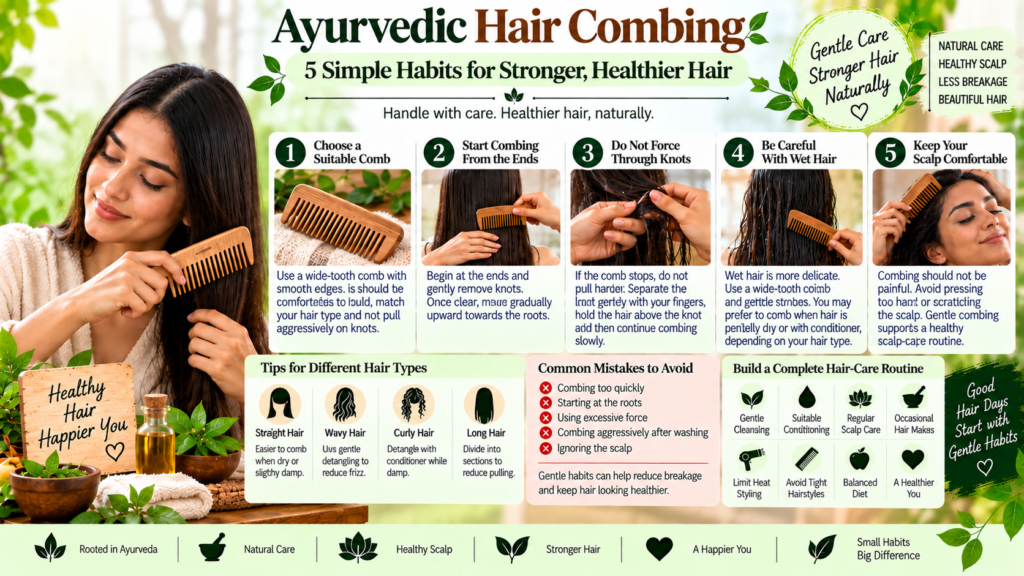
Combing looks like a very basic part of hair care, but the way you handle your hair can make a difference. Pulling through knots, using too much force or repeatedly brushing tangled hair can cause unnecessary breakage.
Ayurvedic hair combing focuses on gentle handling and making combing part of a regular hair-care routine.
You do not need a complicated technique. A few careful habits can make everyday combing easier and more comfortable.
What Is Ayurvedic Hair Combing?
Ayurvedic hair combing refers to gentle hair-combing practices inspired by traditional Ayurvedic hair care.
The focus is on handling the hair and scalp carefully rather than combing aggressively.
A simple approach is:
Detangle gently → Start from the ends → Work upward → Avoid excessive pulling
The right method can also depend on your hair texture, length and condition.
1. Choose a Suitable Comb
The comb you use matters.
A wide-tooth comb can be useful when your hair has knots or needs gentle detangling. It gives the hair more space between the teeth and can make it easier to work through tangles.
Look for a comb that:
- Has smooth edges
- Does not scratch the scalp
- Is comfortable to hold
- Matches your hair type
- Does not pull aggressively on knots
There is no single comb that is perfect for everyone.
2. Start Combing From the Ends
One of the simplest ways to reduce pulling is to start at the ends.
Take a small section of hair and gently remove the knots near the bottom. Once that section is clear, move slightly higher.
Continue working upward until you reach the roots.
This method prevents you from dragging a large knot through the entire length of your hair.
Dermatologists also recommend starting at the ends and gradually working toward the roots when detangling. (American Academy of Dermatology)
3. Do Not Force the Comb Through Knots
If the comb stops at a knot, do not pull harder.
Instead:
- Stop combing.
- Separate the knot gently with your fingers.
- Hold the hair above the knot.
- Loosen the tangled section.
- Continue combing slowly.
Holding the hair above the knot can reduce tension on the scalp.
This small change can make your hair-care routine much gentler.
4. Be Careful With Wet Hair
Hair can be more vulnerable to damage when wet, so it should be handled carefully after washing.
For straight hair, you may find it easier to allow the hair to dry somewhat before gentle combing.
For curly or textured hair, detangling while damp with suitable conditioning may work better.
There is no need to use exactly the same method for every hair type.
If you wash your hair regularly, our guide on How to Wash Hair in Summer can also help you build a gentler washing routine.
5. Keep Your Scalp Comfortable
Combing should not feel painful.
Avoid pressing the comb forcefully against the scalp or repeatedly scratching the same area.
Gentle combing can become part of a broader scalp-care routine that includes appropriate cleansing and suitable hair products.
For more information, read our Ayurvedic Scalp Care guide.
Ayurvedic Hair Combing According to Hair Type
Different hair textures need different approaches.
Straight Hair
Straight hair may be easier to comb when it is dry or slightly damp, depending on its condition.
Start at the ends and gradually move toward the roots.
Wavy Hair
Frequent dry brushing may disturb the natural wave pattern and create frizz.
Gentle detangling with a suitable comb can be more practical.
Curly Hair
Curly hair often develops knots more easily.
Using conditioner and gently separating sections while the hair is damp can make detangling easier.
Long Hair
Divide long hair into sections instead of trying to comb everything at once.
This reduces pulling and makes it easier to find individual knots.
How Often Should You Comb Your Hair?
There is no universal number of times you need to comb your hair each day.
Your hair texture, hairstyle and personal routine all matter.
Instead of focusing on a fixed number, focus on gentle handling.
If your hair is already easy to manage, excessive combing is unnecessary. If it tangles easily, careful detangling when needed may be more useful.
Common Hair-Combing Mistakes
Some everyday habits can increase unnecessary hair breakage.
Combing Too Quickly
Rushing through knots can lead to pulling.
Starting at the Roots
This can push tangles toward the ends and make them harder to remove.
Using Excessive Force
A comb should not need to be forced through a knot.
Combing Aggressively After Washing
Wet hair requires careful handling.
Ignoring the Scalp
If combing regularly causes pain, itching or irritation, the underlying scalp problem should not be ignored.
Does Combing Make Hair Grow Faster?
Gentle combing should not be considered a proven method for increasing hair growth.
Hair growth is influenced by many factors, including genetics, hormones, nutrition and overall health.
The main benefit of careful combing is better hair handling and reduced unnecessary mechanical stress, not guaranteed faster growth.
If you are experiencing persistent hair shedding or noticeable thinning, consider speaking with a dermatologist.
Build a Simple Ayurvedic Hair-Care Routine
Combing works best when it is part of a broader routine.
You can combine gentle ayurvedic hair combing with:
- Appropriate hair washing
- Suitable conditioning
- Regular scalp care
- Occasional hair masks
- Limited excessive heat styling
- Avoiding very tight hairstyles
- A balanced diet
You can also read our Ayurvedic Hair Care Tips guide for more practical habits.
Final Thoughts
Ayurvedic hair combing is mainly about gentle handling rather than complicated techniques.
Choose a suitable comb, start from the ends, work through knots slowly and avoid unnecessary pulling. These simple habits can make daily hair care more comfortable and help reduce avoidable mechanical breakage.
Healthy hair care does not have to be complicated. Consistency and gentle handling are often more useful than constantly changing your routine.