
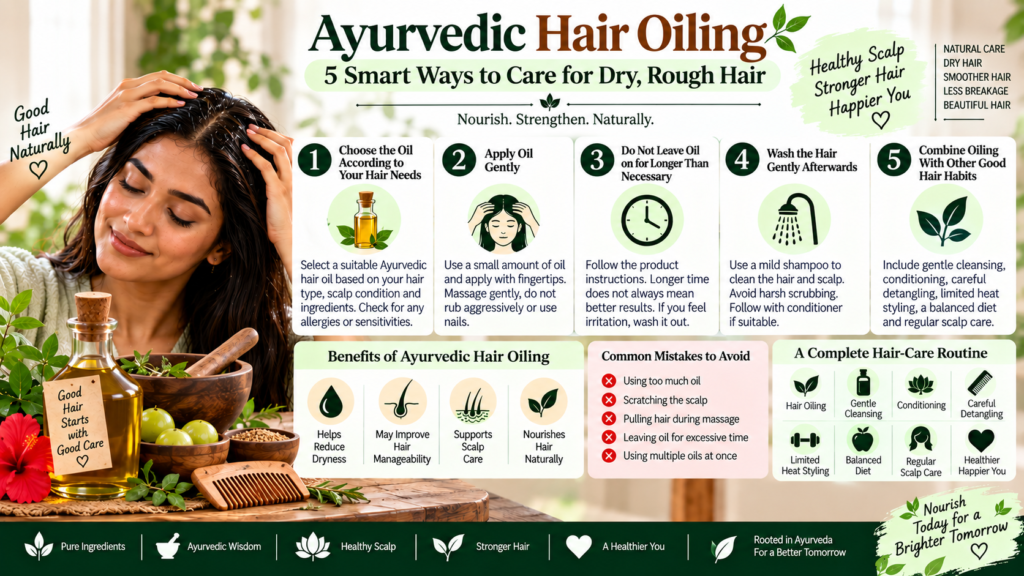
Dry and rough hair can become difficult to manage, especially when it is exposed to heat, pollution, frequent washing or styling. Ayurvedic hair oiling is a traditional hair-care practice that can be included in a simple routine when the chosen oil suits your hair and scalp.
Hair oiling is not a cure for hair loss or scalp disease. Its practical role is mainly related to conditioning, reducing dryness and making hair easier to manage.
What Is Ayurvedic Hair Oiling?
Ayurvedic hair oiling involves applying a suitable oil to the hair or scalp as part of traditional Ayurvedic hair care.
Different oils and herbal preparations are used in Ayurvedic traditions. However, more oil does not necessarily mean better results.
The most useful approach is to choose a suitable product and apply it gently.
1. Choose the Oil According to Your Hair Needs
Not every hair oil will feel the same on every person.
If your hair is dry and rough, you may prefer a conditioning oil that makes the hair feel smoother and easier to manage.
When choosing an oil, check:
- Ingredients
- Product instructions
- Your hair type
- Your scalp condition
- Any known allergies or sensitivities
Avoid assuming that an ingredient is safe for you simply because it is described as natural.
2. Apply Oil Gently
Hair oiling should not involve aggressive rubbing.
Take a small amount of oil and spread it gently over the scalp or hair according to the product instructions.
If you massage the scalp, use your fingertips rather than scratching with your nails.
Gentle application is particularly important if your scalp is sensitive.
For more everyday scalp-care habits, see our Ayurvedic Scalp Care guide.
3. Do Not Leave Oil on for Longer Than Necessary
A common belief is that leaving oil on overnight or for many hours must produce better results.
There is no need to follow this rule for every product or hair type.
Follow the instructions of the particular oil you are using. If your scalp becomes itchy, uncomfortable or irritated after oiling, wash it out and discontinue use.
A simple routine that suits your scalp is more useful than following a fixed number of hours.
4. Wash the Hair Gently Afterwards
After oiling, use a suitable shampoo to clean the scalp and hair.
There is no need to scrub aggressively just because oil has been applied.
A gentle wash is usually enough when the correct amount of oil has been used.
You can also read our guide on How to Wash Hair in Summer for practical hair-washing habits.
5. Combine Oiling With Other Good Hair Habits
Hair oil alone cannot replace basic hair care.
A simple routine can include:
- Gentle hair washing
- Suitable conditioning
- Careful detangling
- Limited excessive heat styling
- Avoiding very tight hairstyles
- Regular scalp care
- A balanced diet
You can learn more in our Ayurvedic Hair Care Tips guide.
Ayurvedic Hair Oiling for Dry Hair
If your main concern is dryness, avoid using excessive amounts of oil.
Instead:
Step 1: Choose a suitable hair oil.
Step 2: Apply a small amount evenly.
Step 3: Massage gently if applying to the scalp.
Step 4: Leave it according to the product instructions.
Step 5: Wash gently.
Step 6: Use conditioner if suitable for your hair.
This keeps the routine simple without making the hair unnecessarily greasy.
Hair Oiling vs Hair Conditioning
Hair oil and conditioner serve different purposes.
| Hair Oiling | Hair Conditioning |
| Uses an oil-based product | Uses a conditioning formulation |
| May be used before washing | Commonly used after shampooing |
| Can help hair feel less dry | Helps improve softness and manageability |
| Frequency depends on hair and scalp | Often suitable for regular use |
You can use one or both depending on your hair-care routine.
When Should You Avoid Scalp Oiling?
Oiling may not be suitable for every scalp condition.
Be cautious if you have:
- An irritated scalp
- Open wounds
- A known allergy to the oil
- A reaction after previous use
- A scalp condition that worsens with particular products
If you have persistent itching, scaling, redness, painful areas or significant hair loss, consult a dermatologist rather than relying only on home hair-care practices.
Does Ayurvedic Hair Oiling Stop Hair Fall?
Ayurvedic hair oiling should not be presented as a guaranteed treatment for hair loss.
Hair shedding can happen for many reasons, including genetics, hormonal changes, nutritional problems, illness and scalp conditions.
Oiling may help with the feel and manageability of dry hair, but it does not address every possible cause of hair loss.
If hair shedding is sudden, persistent or accompanied by visible thinning or bald patches, professional evaluation is appropriate.
Common Hair-Oiling Mistakes
Using Too Much Oil
More oil does not automatically provide more benefit. Excess oil can simply make washing more difficult.
Scratching the Scalp
Use your fingertips gently rather than your nails.
Pulling Hair During Massage
Avoid forceful rubbing or tugging.
Leaving Oil on for Excessive Periods
Follow the product’s recommended usage rather than assuming longer is better.
Using Multiple Oils at Once
Combining many ingredients can make it difficult to know which product suits your scalp.
Final Thoughts
Ayurvedic hair oiling can be a simple addition to a hair-care routine, especially when your hair feels dry or rough.
Keep the process gentle: choose a suitable oil, apply a reasonable amount, avoid aggressive massage and wash the hair properly afterwards.
Most importantly, treat oiling as one part of hair care—not as a guaranteed solution for every hair or scalp problem.