
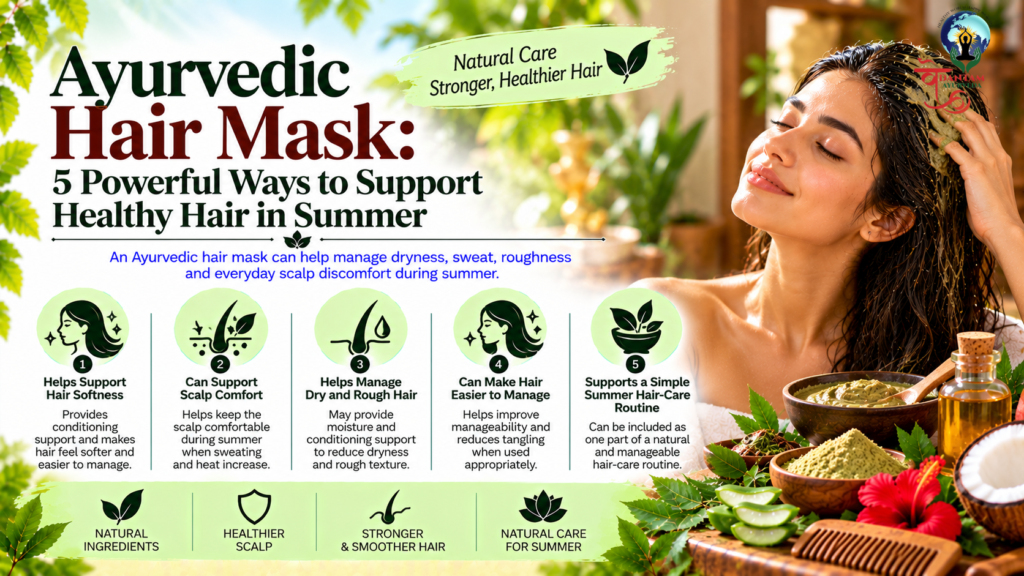
Summer can be challenging for hair and scalp. Heat, sweating, dust, frequent washing and outdoor exposure may make hair feel dry, rough, oily or difficult to manage.
An Ayurvedic hair mask can be included in a simple hair-care routine when it is suitable for your hair and scalp. Traditional Ayurvedic hair care often uses plant-based ingredients and oils, but the right approach depends on individual needs.
A hair mask should not be treated as a cure for hair loss or a scalp disease. Instead, it can be used as one part of regular hair and scalp care.
What Is an Ayurvedic Hair Mask?
An Ayurvedic hair mask is a hair-care preparation inspired by traditional Ayurvedic practices and commonly made with plant-based or herbal ingredients.
Depending on the formulation, a hair mask may be used to support:
- Hair softness
- Manageability
- Scalp comfort
- Moisture
- A healthier-looking appearance
- General hair care
Different ingredients have different properties, and not every ingredient is suitable for every person.
Always check the ingredients before applying a new preparation to your scalp.
1. Helps Support Hair Softness
Summer heat and frequent hair washing can sometimes leave hair feeling rough or dry.
A suitable hair mask may provide conditioning support and make the hair feel softer and easier to manage.
This can be particularly useful when hair becomes:
- Rough
- Dry
- Frizzy
- Difficult to comb
- Less manageable
However, a hair mask cannot permanently repair severely damaged hair. Damaged hair generally requires careful handling and appropriate hair-care practices.
2. Can Support Scalp Comfort
Summer sweating can make the scalp feel uncomfortable.
A suitable Ayurvedic hair mask may be incorporated into a scalp-care routine when the formulation is appropriate for the individual’s scalp.
However, avoid applying heavy or strongly fragranced preparations to an irritated scalp without professional advice.
If you experience persistent:
- Itching
- Redness
- Burning
- Pain
- Scaling
- Sores
the underlying cause should be assessed rather than relying only on a hair mask.
3. Helps Manage Dry and Rough Hair
Hair may become dry because of frequent washing, heat exposure, styling or environmental conditions.
A conditioning hair mask can be useful when the main concern is dryness and rough texture.
For better results, combine it with simple habits such as:
- Gentle shampooing
- Avoiding excessive heat styling
- Using a suitable conditioner
- Drying hair gently
- Avoiding aggressive brushing
The American Academy of Dermatology recommends gentle hair-care practices and avoiding unnecessary damage from excessive heat and rough handling.
You can read more about healthy hair-care practices.
4. Can Make Hair Easier to Manage
Hair that becomes tangled or rough can be difficult to comb.
A suitable mask may help improve the feel and manageability of the hair.
After applying a hair mask:
- Follow the recommended application time.
- Rinse thoroughly.
- Avoid aggressive rubbing.
- Dry the hair gently.
- Comb carefully once the hair is manageable.
Do not leave a product on your scalp longer than recommended simply because you expect better results.
5. Supports a Simple Summer Hair-Care Routine
The biggest benefit of using an Ayurvedic hair mask may be that it can become one manageable part of a broader hair-care routine.
A simple summer routine can include:
- Washing according to scalp needs
- Keeping the scalp comfortable after heavy sweating
- Using a suitable conditioner
- Protecting hair from excessive heat
- Limiting unnecessary styling
- Using a hair mask when appropriate
You do not need to use many products to maintain healthy-looking hair.
How to Use an Ayurvedic Hair Mask
The exact method depends on the formulation.
A general approach is:
Step 1: Start With Clean or Suitable Hair
Follow the product’s instructions regarding whether it should be applied before or after washing.
Step 2: Apply Carefully
Distribute the preparation evenly through the intended areas.
Avoid getting products into the eyes.
Step 3: Follow the Recommended Time
Do not assume that keeping a mask on for several hours will automatically improve the result.
Step 4: Rinse Thoroughly
Remove the preparation properly so that residue does not remain unnecessarily on the scalp or hair.
Step 5: Observe Your Hair and Scalp
If you experience burning, itching or irritation, stop using the product.
Ayurvedic Hair Mask for Different Hair Needs
Dry Hair
A conditioning mask may be useful when the main concern is dryness and rough texture.
Oily Scalp
Avoid excessively heavy formulations and pay attention to how quickly your scalp becomes greasy.
Frizzy Hair
Gentle conditioning and reduced heat exposure may help improve manageability.
Normal Hair
A simple routine may be sufficient without frequent treatments.
Sensitive Scalp
Check ingredients carefully and perform appropriate precautions before using a new product.
Ayurvedic Hair Mask in Summer
Summer hair care is not only about applying a mask.
Heat and sweating may require changes to your normal routine.
If You Sweat Heavily
Clean the scalp when necessary rather than leaving excessive sweat and oil for long periods.
If Hair Feels Dry
Focus on gentle cleansing and conditioning rather than repeatedly applying multiple products.
If You Spend Time Outdoors
Protect your hair and scalp from excessive environmental exposure when practical.
If You Exercise Regularly
Adjust your washing routine according to how oily and sweaty your scalp becomes.
Can You Use a Hair Mask Every Day?
Usually, there is no need to use a hair mask every day.
The appropriate frequency depends on:
- Hair type
- Scalp condition
- Product formulation
- How frequently you wash your hair
- How your hair responds
Using too many products can sometimes create unnecessary buildup.
Follow the instructions for the specific formulation rather than assuming more frequent use will provide better results.
Common Hair Mask Mistakes
Using Too Much Product
More product does not necessarily mean better results.
Applying Everything to the Scalp
Some masks are intended mainly for the hair lengths rather than the scalp.
Check the product instructions.
Leaving the Mask on for Too Long
Follow the recommended application time.
Using a New Product on Irritated Skin
Avoid experimenting with new products on already irritated or damaged skin.
Expecting a Hair Mask to Stop Hair Loss
Hair loss can have many causes. A hair mask should not be presented as a treatment for underlying medical causes of hair loss.
Using Too Many Hair Products
A simple routine is often easier to maintain than a routine containing many unnecessary products.
Ayurvedic Hair Mask vs Hair Oil
Both can be part of traditional hair-care routines, but they serve different purposes.
| Ayurvedic Hair Mask | Hair Oil |
| Usually applied as a short treatment | Usually applied as an oiling treatment |
| May focus on conditioning | Commonly used for oiling and hair-care routines |
| Usually rinsed after use | Usually requires cleansing after oiling |
| Formulation varies | Formulation varies |
| Frequency depends on product | Frequency depends on scalp and hair needs |
Neither is automatically suitable for every person.
When Should You Avoid a Hair Mask?
Be cautious if you have:
- Open wounds on the scalp
- Severe irritation
- Active scalp infection
- Known allergy to an ingredient
- Significant unexplained hair loss
- Severe inflammation
If you are unsure whether a product is suitable, speak with an appropriate professional.
Why Choose Vedantam Ayurveda?
Vedantam Ayurveda includes Ayurvedic hair masks among its hair-care services, along with Shirodhara, herbal hair oils, Nasya and other traditional approaches.
The clinic’s Ayurvedic services page provides more information about its skin and hair-care services.
You can also learn more about Vedantam Ayurveda.
Our Contact
- Phone: +91-9205678439
- Email: support@vedantamayurveda.com
- Address: MZL 07/08, Sumedha Tower, Ansal Building, Raj Nagar, Ghaziabad, Uttar Pradesh