
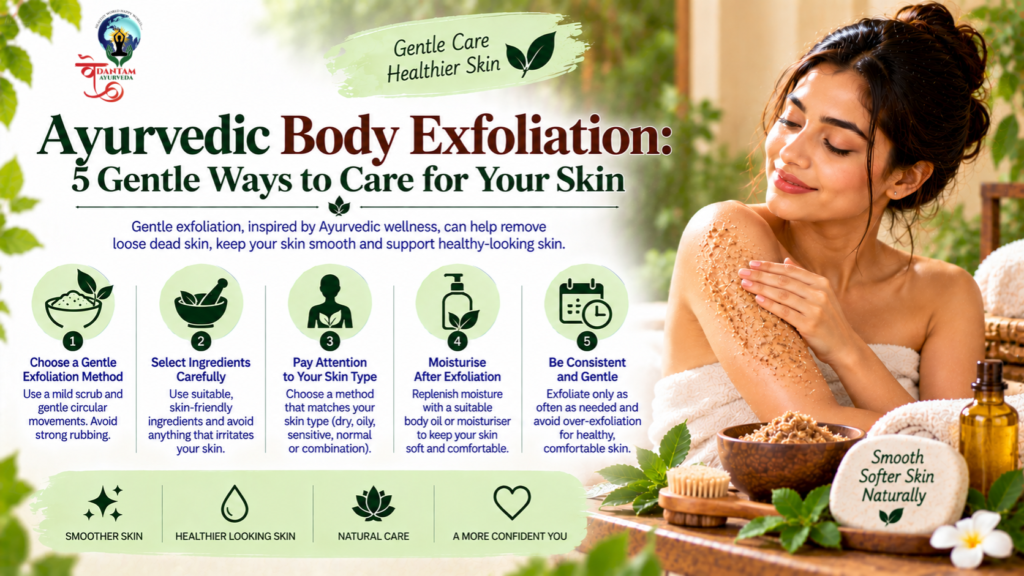
Skin naturally sheds old cells over time. However, the outer layer of the skin can sometimes feel rough, dry or uneven, especially on areas such as the elbows, knees, arms and legs.
This is where exfoliation can become part of a personal skin-care routine.
Ayurvedic body exfoliation refers to gentle exfoliation practices inspired by traditional Ayurvedic personal care. The idea is not to scrub the skin as hard as possible. Instead, the focus should be on gentle care, suitable ingredients and paying attention to how your skin responds.
Exfoliation is not suitable for everyone or every skin condition. The American Academy of Dermatology explains that exfoliation needs to be chosen according to skin type and should be done gently because excessive exfoliation can cause irritation, redness or breakouts.
What Is Ayurvedic Body Exfoliation?
Ayurvedic body exfoliation means using gentle exfoliation as part of an Ayurvedic-inspired skin-care routine.
Traditional Ayurvedic skin care has included plant-based powders, pastes, oils and bathing practices. However, modern skin care teaches an important point: even natural ingredients can irritate the skin if they are too strong, used too often or applied to already irritated skin.
A simple approach is therefore better.
The goal should be to:
- Keep the skin clean
- Remove loose dead skin gently
- Support comfortable skin
- Avoid excessive rubbing
- Moisturise after exfoliation
- Choose products according to your skin type
1. Choose a Gentle Exfoliation Method
Not every scrub is suitable for every person.
Some body scrubs contain coarse particles that can feel rough when rubbed against the skin. If you use a physical scrub, apply it gently instead of pressing hard.
You can use gentle circular movements for a short period and then rinse with lukewarm water.
The American Academy of Dermatology recommends being gentle when exfoliating and avoiding aggressive methods that can damage the skin.
For Ayurvedic body exfoliation, this means that the quality of the technique matters as much as the ingredient.
Avoid:
- Strong rubbing
- Long exfoliation sessions
- Scrubbing already irritated skin
- Using several exfoliating products together
- Exfoliating every day without a reason
2. Select Ingredients Carefully
Traditional Ayurvedic skin care may use ingredients such as herbal powders and plant-based preparations.
However, you should not assume that every natural ingredient is automatically suitable for your skin.
Before using a new product or homemade preparation, consider whether your skin is sensitive or prone to irritation.
A gentle body-care routine may use a suitable cleanser followed by moisturisation rather than relying on strong scrubbing.
If an ingredient causes burning, itching, redness or discomfort, stop using it.
A simple rule:
Natural does not always mean suitable for everyone.
This is especially important when using homemade skin-care mixtures.
3. Pay Attention to Your Skin Type
Your skin type can affect how often you should exfoliate.
Dry Skin
If your skin is already dry or flaky, aggressive exfoliation may make the dryness worse.
Use a gentle method and follow it with moisturiser.
Sensitive Skin
Sensitive skin may react quickly to scrubbing or strongly fragranced products.
A very gentle approach is more appropriate.
Oily Skin
Some people with oily skin may tolerate exfoliation better, but excessive scrubbing can still irritate the skin.
Normal Skin
You can maintain a simple routine based on how your skin feels rather than exfoliating simply because it is part of a routine.
Combination Skin
Different areas may respond differently, so avoid treating the entire body with an unnecessarily strong method.
The AAD specifically recommends considering skin type before choosing an exfoliation method.
4. Moisturise After Exfoliation
Exfoliation can leave the skin feeling temporarily dry, particularly if the method is too strong.
After rinsing, gently dry your skin and apply a suitable moisturiser.
This step is important because the goal of Ayurvedic body exfoliation is not simply to remove dead skin. The complete routine should also help maintain comfortable, moisturised skin.
A simple sequence can be:
Clean → gently exfoliate → rinse → moisturise.
There is no need to add many products.
5. Do Not Exfoliate Damaged Skin
Exfoliation should not be performed on skin that is already damaged.
Avoid exfoliating areas with:
- Open cuts
- Fresh wounds
- Sunburn
- Active irritation
- Severe redness
- Significant inflammation
The AAD recommends avoiding exfoliation on open cuts and wounds and on sunburned skin.
If you have an existing skin condition, it is better to ask a dermatologist whether exfoliation is appropriate.
Ayurvedic Body Exfoliation: How Often Should You Do It?
There is no universal schedule that works for everyone.
Your skin type, the exfoliation method and the strength of the product all matter.
A very aggressive exfoliation method should not be repeated frequently.
If your skin becomes:
- Red
- Painful
- Very dry
- Burning
- Itchy
- More sensitive
reduce or stop exfoliation.
The AAD notes that over-exfoliation can lead to irritated and red skin, and that the more aggressive the method, the less frequently it should generally be used.
Best Areas for Gentle Body Exfoliation
Some areas commonly feel rougher than others.
Elbows
Elbows can become dry because of repeated friction and pressure.
Knees
Knees may also feel rough or dry, especially during periods of low humidity.
Arms
Gentle exfoliation may be part of a regular body-care routine if your skin tolerates it.
Legs
Dry skin on the legs may benefit from gentle cleansing and moisturising.
However, rough skin can sometimes be related to a skin condition. Persistent or unusual changes should not automatically be treated with stronger scrubbing.
Ayurvedic Body Exfoliation and Bathing
Exfoliation can fit naturally into a bathing routine.
You can keep the process simple:
Step 1: Wet the Skin
Use comfortable, lukewarm water.
Step 2: Clean the Skin
Use a suitable cleanser if needed.
Step 3: Exfoliate Gently
Use a suitable exfoliating product or traditional preparation without applying excessive pressure.
Step 4: Rinse
Remove the product thoroughly.
Step 5: Moisturise
Apply a suitable moisturiser while the skin is still comfortable and slightly hydrated.
This approach avoids making exfoliation the entire focus of skin care.
Common Body Exfoliation Mistakes
Scrubbing Too Hard
More pressure does not mean cleaner or healthier skin.
Exfoliating Every Day
Daily exfoliation is not necessary for everyone and may cause irritation.
Using Very Rough Scrubs
Coarse particles can be irritating, particularly when used with strong pressure.
Ignoring Your Skin Type
A product that works for one person may not suit another.
Forgetting Moisturiser
Skin can feel dry after exfoliation, so moisturising is an important follow-up step.
Exfoliating Irritated Skin
This can make irritation worse.
What About Homemade Ayurvedic Scrubs?
Homemade scrubs are popular because they can be simple and inexpensive.
Traditional ingredients may include different herbal powders or other plant-based materials.
However, homemade does not automatically mean risk-free.
Consider:
- Whether the ingredient is suitable for your skin
- Whether it has a rough texture
- Whether you have sensitive skin
- Whether the preparation is clean
- Whether you have any existing skin irritation
Do not use an ingredient simply because it is described as “natural.”
If you are unsure about an ingredient, professional skin-care advice is safer.
Ayurvedic Body Exfoliation for a Simple Weekly Routine
If your skin tolerates exfoliation, you can keep your routine simple.
Before Bathing
Prepare your skin and choose a gentle product.
During Bathing
Apply the exfoliating product gently rather than aggressively rubbing.
After Bathing
Pat the skin dry and apply moisturiser.
Between Exfoliation Days
Focus on normal cleansing and moisturising.
You do not need to exfoliate repeatedly to maintain healthy-looking skin.
When Should You Avoid Exfoliation?
You may need to avoid exfoliation if your skin is:
- Sunburned
- Cut or wounded
- Very irritated
- Extremely sensitive
- Experiencing a significant rash
- Recently treated with a procedure that affects the skin barrier
People using certain medicines or skin-care products that increase sensitivity should also check with a dermatologist before adding exfoliation. The AAD specifically notes that some products and medicines can make skin more sensitive or cause peeling.
When Should You See a Dermatologist?
If you have persistent roughness, severe dryness, unexplained redness, itching, a rash or recurring skin irritation, exfoliation may not be the solution.
A dermatologist can help determine the underlying cause.
Do not keep increasing the strength or frequency of exfoliation when your skin is getting worse.
Ayurvedic Body Exfoliation: Simple Routine to Remember
You can remember five basic points:
Choose gently.
Do not use unnecessarily harsh scrubs.
Know your skin.
Choose a routine according to your skin type.
Do not overdo it.
Exfoliation does not need to happen every day.
Moisturise afterward.
Support comfortable, hydrated skin.
Stop when skin reacts.
Burning, pain or significant irritation means it is time to stop.
Why Choose Vedantam Ayurveda?
Vedantam Ayurveda provides Ayurvedic skin and hair-care services based on traditional Ayurvedic approaches and personalised care. Its listed skin services include herbal facials, oil massages and other skin-care therapies.
You can learn more about Vedantam Ayurveda’s skin and hair services.
Our Contact
- Phone: +91-9205678439
- Email: support@vedantamayurveda.com
- Address: MZL 07/08, Sumedha Tower, Ansal Building, Raj Nagar, Ghaziabad, Uttar Pradesh