
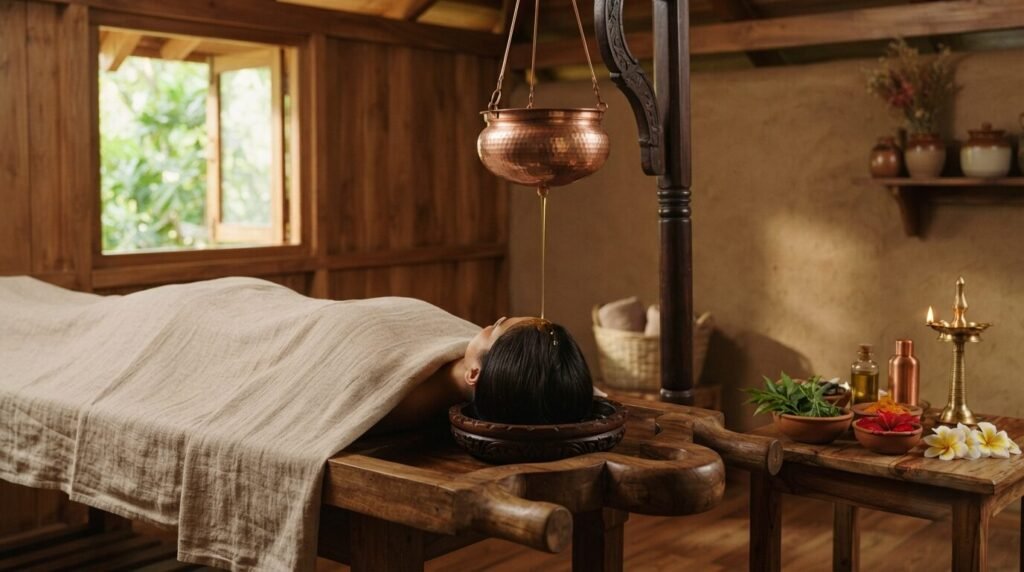
A friend of mine tried Shirodhara last year after months of barely sleeping through the night. She went in expecting some kind of head massage. What she got instead was thirty-five minutes of warm oil trickling across her forehead in a single unbroken stream, and by the end of it she said her mind had gone quieter than it had in weeks. That’s usually how people describe it once they’ve actually experienced it. Reading about it beforehand doesn’t quite prepare you.
If you’ve been considering it, for stress, poor sleep, or just because everyone at your local Ayurvedic clinic keeps recommending it, here’s a proper look at what it involves, what it costs, and whether it’s likely to help your specific situation.
What is Shirodhara, really?
Break the word down and it’s fairly literal. “Shiro” means head. “Dhara” means a continuous flow or stream. Put together, that’s the entire treatment: warm oil (or occasionally buttermilk or a herbal decoction) poured steadily over the forehead for a set period.
It’s an old technique, mentioned in classical Ayurvedic texts long before anyone was calling it a “wellness therapy.” The oil is released from a pot suspended above your head, traditionally made of copper, though most clinics now use a mechanised version that keeps the flow perfectly even. You just lie there. No pressure, no kneading, nothing that resembles a massage in the usual sense. That’s actually the whole trick: the constant, rhythmic sensation is what seems to calm the nervous system down.
What happens during a session
Most clinics start with a short consultation. They’ll ask what’s bothering you, trouble sleeping, constant low-level anxiety, tension headaches, whatever brought you in, because the oil blend and duration often change depending on the answer.
After that comes a brief head-and-shoulder massage, mostly to help you settle before the actual dhara begins. Then you lie down on a treatment table, head positioned under the pot, and the pouring starts. It usually runs for 20 to 40 minutes. Somewhere around the ten-minute mark, most people stop noticing the sensation as unusual and just… drift. A fair number actually fall asleep.
Afterward you’re given a few minutes to sit up slowly; jumping straight off the table isn’t a great idea since some lightheadedness is common right after.
One thing worth knowing going in: a single session feels nice, but it’s rarely the point. Clinics almost always push you toward a course, five days, seven days, sometimes fourteen, because the effect tends to build cumulatively rather than showing up all at once.
The oil actually matters
Not every Shirodhara session uses the same oil, even though it might look identical from the outside. For stress and anxiety, sesame oil infused with Brahmi or Ashwagandha is fairly standard. Trouble sleeping tends to call for something a bit heavier and warming. And for certain skin-related concerns, some practitioners switch to buttermilk or a medicated milk decoction instead of oil altogether.
If a clinic doesn’t ask about your constitution or what you’re hoping to fix before picking an oil, that’s worth noticing. It’s a small detail, but it’s the difference between a treatment that’s tailored to you and one that’s just going through the motions.
Who tends to benefit from it
Ayurveda frames Shirodhara as something that pacifies Vata, the dosha most connected to the nervous system, movement, and mental activity. Translated into plain terms, people usually turn to it for:
- Ongoing stress that doesn’t seem to switch off
- Sleep that’s light, interrupted, or just hard to fall into
- Anxiety, racing thoughts, that wired-but-tired feeling
- Tension headaches and some forms of migraine
- General burnout or mental exhaustion
It’s not a cure for a diagnosed anxiety disorder or clinical insomnia, and no honest practitioner will tell you it is. Think of it more as a genuinely effective support, something that works well alongside proper sleep habits or medical treatment, not instead of them.
When it’s better to skip it
It’s a gentle therapy, but that doesn’t mean it suits absolutely everyone. Hold off, or check with a doctor first, if any of these apply to you:
- You’re pregnant, particularly in the first trimester
- You currently have a fever or an active infection
- You’ve had a recent head injury
- Your blood pressure is high and not well controlled
- You know you’re sensitive or allergic to sesame or similar oils
A clinic that skips asking about any of this before starting the treatment isn’t one I’d go back to, honestly.
Does it have side effects?
Not really, if it’s done properly. A little grogginess right after is common and usually gone within twenty minutes. Your hairline might feel oily for the rest of the day, which is just the oil doing its job. Very occasionally someone gets a mild headache, usually because the oil was slightly too warm or too cool. Genuine allergic reactions are rare but not impossible, which is another reason the oil should match your skin and constitution rather than being whatever’s on hand that day.
A few aftercare basics
- Don’t wash your hair right away; give the oil a few hours to actually absorb
- Skip a cold shower immediately after; your body’s still settling
- Sit or rest for fifteen-odd minutes before driving anywhere
- Drink water through the day
- Go easy on heavy or oily food that evening
- If you can, keep the following night free; that’s often when people notice the deepest sleep
So, is it worth trying?
If stress or bad sleep has been dragging on for a while and you haven’t found much that helps, yes, it’s worth a shot. It’s low-risk, it doesn’t involve needles or chemicals, and even sceptics tend to come out of the first session a little surprised by how calm they feel. Just don’t expect it to fix everything on its own. Pair it with decent sleep habits and, if things are serious, an actual medical opinion, and you’ll get a lot more out of it.
Common questions people ask
Is it safe for everyone? Mostly, yes, but pregnant women, people with uncontrolled high blood pressure, and anyone with a neurological condition should run it by their doctor first.
How fast will I feel a difference? Some people notice something after just one session. For it to actually stick, though, five to seven sessions in a row is closer to the norm.
Will it help with hair fall? It’s not designed for that specifically, but the herbal oils used do nourish the scalp, so people often notice their hair looking a bit healthier after a course.
Can I do it while I’m on my period? Most clinics suggest waiting out the first couple of days and coming in once the flow’s lighter, just mention it when you book.
Isn’t this the same as a head massage? Not really. A massage involves pressure and kneading. Shirodhara is just the steady pour, no pressure at all, and it works on the body differently because of that.
How soon can I shampoo afterward? A few hours minimum. If you can leave it overnight, even better; the oil has more time to do something useful.
Can I try this at home? Technically, sure, but keeping the oil at a steady temperature and flow rate without proper equipment is harder than it looks. Best to get a few sessions done at a clinic first before even considering it.