
Ayurveda is a word people hear often these days, on product labels, in wellness reels, on clinic boards. But most people only know it as a vague label for anything natural or herbal. Ayurveda is actually a complete science of health and living that is thousands of years old, with its own logic for why the body works the way it does and what keeps it in balance. Once you understand the basics, it stops feeling like a buzzword and starts making practical sense.
Ayurveda at a Glance
| Meaning | Science of Life (Ayu = life, Veda = knowledge) |
| Origin | Ancient India, over 3,000 years old |
| Core Principles | Doshas, Agni, Prakriti, Panchamahabhutas |
| Main Branches | Ashtanga Ayurveda (8 branches of practice) |
| Key Therapies | Panchakarma, herbal formulations, Dinacharya (daily routine) |
| Commonly Used For | Hair fall, skin concerns, digestion, stress, general wellness |
| Best Results | Consistent lifestyle habits alongside professional guidance |
What Does Ayurveda Actually Mean
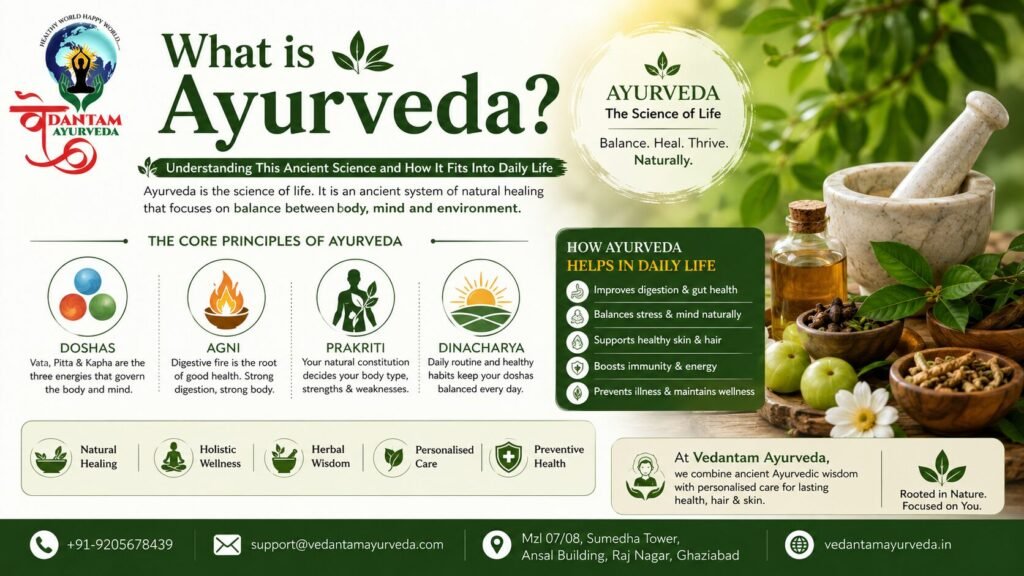
The word Ayurveda comes from two Sanskrit words, Ayu meaning life, and Veda meaning knowledge or science. Put together, it means the science of life. It is one of the oldest structured systems of medicine in the world, developed in ancient India, and it looks at health as a state of balance between the body, mind and environment, not just the absence of disease.
Unlike systems that treat symptoms one at a time, Ayurveda looks at the person as a whole. Two people with the same problem, like acne or hair fall, can get completely different recommendations because Ayurveda considers their body type, digestion, lifestyle and mental state, not just the visible issue.
A Brief History of Ayurveda
Ayurveda’s roots go back over 3,000 years, with its foundations recorded in classical texts that are still referred to by practitioners today. The Charaka Samhita focuses on internal medicine, physiology and treatment principles, while the Sushruta Samhita is considered one of the earliest detailed texts on surgery. Together with the Ashtanga Hridayam, a later text that consolidates earlier knowledge, these works form the classical basis of Ayurvedic practice.
In recent decades, Ayurveda has also been recognised and regulated at a government level in India through the Ministry of AYUSH, which oversees standards, education and research in Ayurveda alongside other traditional systems. This history is worth knowing because it shows Ayurveda is not a wellness trend, but a documented system with centuries of clinical observation behind it.
The Core Ideas Behind Ayurveda
A few concepts show up again and again in Ayurveda, and understanding them makes everything else easier to follow.
• Doshas: Ayurveda describes three energies, Vata, Pitta and Kapha, that govern different functions in the body. Vata controls movement, Pitta controls metabolism and transformation, and Kapha controls structure and stability. Everyone has a mix of all three, with one or two usually more dominant
• Agni, or digestive fire: This is seen as the foundation of good health. When digestion is strong, the body absorbs nutrients well and stays balanced. When it is weak, toxins called Ama build up and eventually show up as fatigue, skin problems or other health issues
• Prakriti: This is a person’s natural constitution, decided at birth. It explains why some people naturally run hot and are prone to skin sensitivity, while others feel cold easily or gain weight faster
• Panchamahabhutas, or the five elements: Ayurveda holds that everything, including the human body, is made up of five elements, Earth, Water, Fire, Air and Space. The three doshas are themselves combinations of these elements, which is why Ayurvedic treatment often works by balancing elemental qualities, such as adding warmth for someone with excess cold and heaviness
• Dinacharya, or daily routine: Ayurveda puts a lot of weight on habits like waking up early, eating at consistent times and winding down properly at night, since these small routines are believed to keep the doshas balanced
The Eight Branches of Ayurveda (Ashtanga Ayurveda)
Classical Ayurveda is organised into eight branches, together called Ashtanga Ayurveda. Knowing these helps explain why Ayurveda covers far more ground than herbal remedies alone.
• Kayachikitsa: General or internal medicine, dealing with whole-body health and chronic conditions
• Shalya Tantra: Surgical procedures and techniques
• Shalakya Tantra: Treatment of conditions related to the eyes, ears, nose and throat
• Kaumarbhritya: Paediatrics, covering child health and development
• Bhuta Vidya: Understanding of mental and psychological conditions
• Agada Tantra: Toxicology, dealing with poisons and their antidotes
• Rasayana: The science of rejuvenation, nutrition and anti-ageing
• Vajikarana: Focused on reproductive health and vitality
How Ayurvedic Diagnosis Works
An Ayurvedic assessment is usually more detailed than a quick symptom check. A practitioner typically looks at Nadi Pariksha (pulse reading), tongue, skin and eye examination, along with a detailed history of diet, sleep, stress levels and digestion. The goal is to identify a person’s Prakriti (natural constitution) and Vikriti (current imbalance), since treatment is built around correcting the gap between the two rather than only addressing a single symptom.
Panchakarma: Ayurveda’s Detox Therapies
Panchakarma refers to a set of five classical detoxification therapies used to clear out accumulated toxins (Ama) and restore dosha balance. These include Vamana (therapeutic emesis), Virechana (purgation), Basti (medicated enemas), Nasya (nasal administration of herbal oils) and Raktamokshana (bloodletting, used rarely and only in specific cases). Panchakarma is typically done under supervision, after a preparatory phase, and is not meant to be attempted without professional guidance.
How Ayurveda Actually Helps in Daily Life
Ayurveda is not only about treating an illness once it shows up. A lot of its value comes from how it shapes everyday habits before problems even start.
• Diet and eating habits: Ayurveda encourages eating according to your body type and the season, rather than following one fixed diet for everyone
• Sleep and routine: Consistent sleep and wake times are considered as important as diet, since disturbed routines are linked to stress, poor digestion and skin issues
• Stress management: Practices like oil massage, breathing exercises and calming therapies are used to manage the mental and physical effects of daily stress
• Skin and hair care: Many common concerns like hair fall, dull skin or acne are approached as signs of an internal imbalance rather than isolated problems, which is why Ayurvedic routines often work on digestion and stress alongside external care
• Preventive health: Ayurveda puts real focus on preventing imbalance in the first place, through diet, routine and seasonal adjustments, rather than only stepping in after something goes wrong
Is Ayurveda Only About Herbs and Oils
Herbs, oils and herbal formulations are a visible part of Ayurveda, but they are only one piece of it. The bigger idea is understanding your own body type and adjusting diet, routine and lifestyle accordingly. A herbal oil works far better when it is paired with the right eating habits and a consistent routine than when it is used alone as a quick fix.
If you are experiencing persistent hair fall, our guide on [insert internal link: Ayurvedic Hair Fall Treatment page] explains how herbal oils are combined with lifestyle changes for better results. The same principle applies to a formulation like our [insert internal link: Kumkumadi Oil product page], which is more effective as part of a routine than as a one-off application.
Ayurveda vs Modern Medicine: How They Differ and Work Together
Modern medicine and Ayurveda are not competitors; they approach health from different starting points. Modern medicine is largely diagnosis and disease focused, using standardised tests and treatments that work the same way for most patients. Ayurveda is constitution focused, building a plan around an individual’s dosha balance, digestion and lifestyle, and tends to take a slower, more gradual approach to results.
In practice, many people use both. Someone might rely on modern diagnostics to confirm a condition, then use Ayurvedic routines and therapies to manage lifestyle-related factors such as stress, digestion, skin health or hair fall. This complementary approach works best when a doctor is kept informed about any Ayurvedic treatment being followed alongside conventional care.
Common Myths About Ayurveda
• Myth: Ayurveda has no side effects. Fact: Like any system of medicine, incorrect dosage, poor quality formulations or self-medication can cause adverse effects. Guidance from a qualified practitioner matters
• Myth: Ayurveda only means herbal products. Fact: Diet, routine, therapies and mental wellbeing are equally central to Ayurveda, not just herbs
• Myth: Results are instant. Fact: Ayurveda generally works on a gradual, cumulative basis rather than through quick fixes
• Myth: Ayurveda cannot be combined with modern medicine. Fact: Many people use both together, provided their doctor is informed
Who Should Be Careful With Self-Medication
Ayurveda is generally considered a gentle system, but that does not mean every remedy is automatically safe for every person. Pregnant women, people on existing medication, those with chronic conditions, and anyone planning to start a new herbal formulation should get a proper consultation first, rather than relying on generic advice found online or guessing their own dosha type. Self-diagnosing based on incomplete information, or mixing multiple strong herbal formulations without guidance, can do more harm than good.
Bringing Ayurveda Into Your Routine
• Start simple. Fix meal timings before adding any new product or herb
• Get familiar with your own body type instead of copying someone else’s routine
• Treat oils, herbs and therapies as consistent habits, not one-time fixes
• For ongoing concerns like hair fall, pigmentation or acne, get a proper assessment instead of guessing your dosha or condition on your own [insert internal link: relevant treatment page]
Where Vedantam Ayurveda Fits In
At Vedantam Ayurveda’s clinic in Raj Nagar, Ghaziabad, these same classical principles are used to build personalised plans for hair and skin concerns. Our team of experienced Ayurvedic doctors carries out a detailed consultation to understand dosha balance, digestion and daily habits before recommending any treatment, rather than offering a one-size-fits-all product.
We work with concerns including hair fall, alopecia, pigmentation, melasma, acne and dull skin, combining classical diagnosis with targeted herbal care. The idea stays the same as classical Ayurveda: look at digestion, dosha balance and daily habits first, and use individualised herbal treatment plans to support the process.
• Explore our Ayurvedic hair and skin products [insert internal link: Shop / Products page]
• Learn more about our clinic in Ghaziabad [insert internal link: About Us page]
If you are unsure which Ayurvedic approach is suitable for your hair or skin concerns, book a consultation with our Ayurvedic doctors in Raj Nagar, Ghaziabad. A personalised assessment helps identify your dosha, lifestyle factors and the most appropriate treatment plan.
Disclaimer
Ayurvedic treatments and herbal formulations work differently for each individual. Results vary depending on the person’s condition, lifestyle and consistency. Please consult a qualified Ayurvedic practitioner before starting any new treatment, especially if you are pregnant, on existing medication, or managing a chronic condition.
Frequently Asked Questions
Q1. Is Ayurveda scientifically proven?
Ayurveda is a traditional system built over thousands of years of observation and practice. Some of its principles, like the link between diet, stress and skin health, align with what modern research also recognises, though it is best approached as a complementary system alongside regular medical care when needed.
Q2. How do I know my dosha type?
A proper dosha assessment is usually done through a consultation with an Ayurvedic practitioner, who looks at your body type, digestion, skin, sleep pattern and other factors, rather than through guesswork.
Q3. Can Ayurveda be used alongside modern medicine?
Yes, many people use Ayurvedic routines and therapies alongside conventional treatment, especially for lifestyle related concerns like stress, digestion, skin and hair health. It is best to inform your doctor about any therapies you are following.
Q4. Do I need to change my whole lifestyle to benefit from Ayurveda?
No, even small consistent changes, like fixed meal timings or a regular sleep schedule, can make a noticeable difference over time. Ayurveda works best as a gradual shift, not an overnight overhaul.
Q5. Is Ayurveda only for treating disease, or also for general wellness?
Both. Ayurveda is used to manage specific health concerns, but a large part of its focus is on prevention and maintaining general wellness through daily habits.
Q6. What is Panchakarma and is it necessary for everyone?
Panchakarma is a set of classical detoxification therapies used to clear accumulated toxins and restore balance. It is not necessary for everyone, and is usually recommended by a practitioner based on an individual’s condition rather than used as a routine wellness treatment for all.
Our Contact
+91-9205678439
support@vedantamayurveda.com
Mzl 07/08 Sumedha Tower, Ansal Building, Ghaziabad
Vedantam Ayurveda offers Ayurvedic hair and skin treatments, along with herbal products, from its clinic in Raj Nagar, Ghaziabad. To book a consultation or explore the product range, visit vedantamayurveda.in.